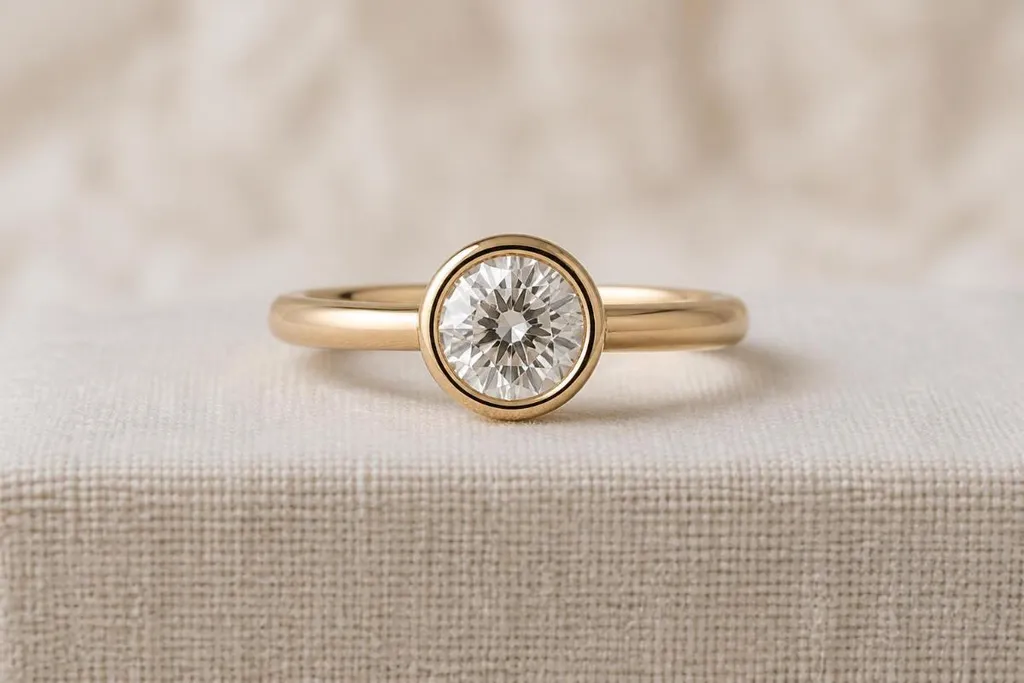
An engagement ring does not need an elaborate setting to make a strong impression. Bezel settings take a cleaner approach, surrounding the edge of a lab-grown diamond with a fine border of precious metal rather than relying on prominent claws. The result is smooth, contemporary and highly distinctive, with the setting becoming part of the diamond's silhouette. For someone who uses their hands frequently or simply prefers streamlined jewellery, the additional coverage around the stone can also offer practical reassurance.
Looking at this ring style is particularly useful for understanding why bezel-set lab diamond engagement rings appeal to modern wearers. Their character comes from the relationship between diamond shape, the surrounding metal and the overall profile—not from adding unnecessary decorative elements.
Why a Bezel Setting Feels So Contemporary
Traditional claw settings are designed to hold a diamond at several individual points. A bezel creates a different visual language by following all or part of the stone's perimeter with metal.
That continuous outline gives the ring a crisp, intentional appearance. Round diamonds become clearly circular, while oval, emerald, pear and other shaped stones can have their silhouettes emphasised by the surrounding border.
This is particularly effective for people who appreciate minimalist jewellery. The design can feel substantial without being ornate because the bezel itself provides structure.
Metal choice changes the effect considerably. White metals can create a more seamless transition between a colourless lab diamond and its setting, while yellow or rose gold introduces a visible frame. The latter can make the diamond's shape stand out more clearly and bring warmth to an otherwise streamlined design.
A bezel can therefore be minimal without being visually neutral.
Added Protection for Everyday Wear
One of the practical attractions of a bezel is the amount of protection it provides around the diamond's perimeter.
Exposed edges and corners can be vulnerable points on certain diamond shapes. By wrapping metal around the circumference, a bezel reduces the amount of exposed edge compared with many conventional claw settings. It can also create a smoother exterior with fewer projecting components likely to catch on clothing.
This does not make the ring indestructible. Fine jewellery still benefits from being removed during heavy manual work, sport or activities involving hard impact. The setting should also be professionally inspected periodically.
For everyday life, however, the streamlined construction can be attractive to people with active routines. Someone working regularly with fabrics, gloves or their hands may value a lower-catching profile just as much as the contemporary appearance.
Practicality, in this case, becomes part of the design rather than an afterthought.
Choosing Diamond Size and Shape
Because the bezel traces the diamond's outline, shape becomes particularly important.
An oval lab diamond can create an elegant lengthening effect, while a round stone delivers strong symmetry. Emerald and radiant cuts introduce sharper geometry, and pear shapes gain additional definition around their distinctive tapered point.
Carat weight should be considered alongside dimensions and proportion. A 2-carat stone may appeal not simply because it is larger than a 1-carat diamond, but because a more generous face-up size can balance the visual presence of the surrounding bezel.
Conversely, a smaller lab diamond in a finely proportioned bezel can produce an intentionally restrained look. For someone who prioritises ease of wear and subtlety, that may be preferable to maximising size.
The width of the metal border matters too. A very fine bezel keeps attention firmly on the diamond, whereas a broader surround makes the metalwork a stronger part of the aesthetic.
Pairing a Bezel Ring with a Wedding Band
The clean architecture of a bezel-set engagement ring can make wedding-band pairing particularly interesting.
A plain band continues the minimalist theme and allows the centre diamond's outlined shape to remain the focus. A pavé or eternity band creates deliberate contrast, placing fine sparkle beside the smoother, more architectural engagement-ring setting.
The height and shape of the bezel should be considered before selecting a wedding ring. Some designs allow a straight band to sit closely alongside the engagement ring, while others may create a small gap or work better with a shaped band.
Metal coordination can also influence the finished stack. Matching metals create continuity, while contrasting tones make the individual rings more distinct.
Final Thought
Bezel-set lab diamond engagement rings offer a persuasive combination of aesthetics and practicality. The surrounding metal defines the diamond's shape, creates a sleek contemporary profile and provides additional protection around its perimeter.
For someone who wants an engagement ring that feels refined without relying on elaborate detailing, a bezel setting is a thoughtful alternative to traditional claws. Its strength lies in simplicity: the diamond, metal and structure each have a clear purpose, resulting in a design that can remain elegant long after passing trends have changed.